
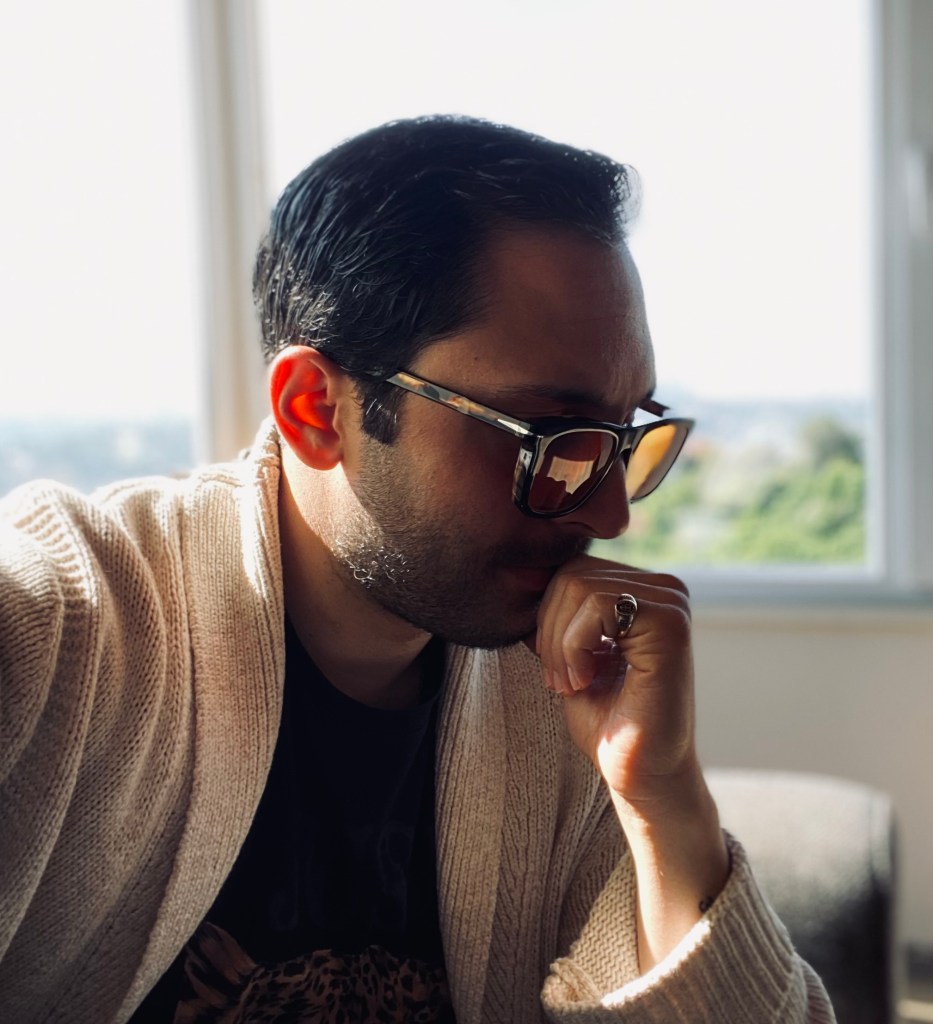
Alp Atabay, PhD
Communication Designer • Brand Strategist • Real Estate Developer • Consultant • Scholar • Sailor • Marine Painter • Historian • Horology Enthusiast
“Largo al factotum della città, largo!“
Dr. Alp “Alpie” Atabay has built a distinguished career at the crossroads of visual media, marketing communications, and strategic leadership. A highly sought-after consultant and creative executive, he has worked across four continents, leading campaigns that range from brand and marketing strategies to political and funding efforts. Currently, he leads Peker, Haim & Derman, a boutique communications strategy agency, while also overseeing a real estate development firm based in Hawaii. Alongside his professional endeavors, Atabay has cultivated a rich personal life filled with artistic, scholarly, and leisure pursuits that reflect his wide-ranging interests and intellectual curiosity.

Alp Atabay’s earliest experience of the relationship between communication and power came not from a boardroom or a classroom but from a stage. As a child in Turkey he performed in two productions with the State Opera’s children’s choir — and what captivated him was not the singing but everything around it: the libretto, the set design, the program booklets that documented each production with the seriousness of a small scholarly edition. He was watching, from the inside, how a complex experience gets made, packaged, and delivered to an audience. He has been studying variations of that question ever since.
That question — how meaning is made, how narratives are constructed, how the words we choose shape the reality we inhabit — runs as a continuous thread through a career that looks, on the surface, unusually varied. Atabay is the Chief Marketing Officer of AmGen Group, a California real estate development firm, and the President of Puainako Heights Land Co., a residential development company in Hawaii. He is the managing partner of Peker, Haim & Derman, a communications consultancy whose clients have ranged across real estate, finance, political advocacy, higher education, and technology on three continents. He holds a PhD from Boston University, completed under the supervision of Sir Christopher Ricks — one of the most celebrated literary scholars of the twentieth century — and a BA in Visual Communication and Design from Bilkent University and an MA in Media Management from the New York Institute of Technology. He designed and taught a course on Stoic philosophy for entrepreneurs and executives at MEF University in Istanbul. He paints at sea. He writes rock songs in Turkish for his band Kurtadamlar. He is currently establishing two new organizations: The Villart, a nonprofit dedicated to residencies for marine artists, and the Istanbul Horological Society, which will fund scholarships for young watchmakers. He is at work on documentary and feature film scripts.
All of those threads — the communications training, the brand strategy work, the doctoral precision about how texts are made and what they do, the philosopher’s attention to the weight of words — converge in his current writing project.
The Genocide Brand: How the World’s Heaviest Word Is Made, Wielded, and Withheld is the project in which all of Atabay’s intellectual and professional preoccupations converge. Its subject is a single word — genocide — and the political, media, and communicative processes by which that word is assigned to some mass atrocities and withheld from others. Its central argument is that those processes are best understood not only through the established lenses of international law and historiography, but through the analytical tools of communications theory, brand strategy, and cognitive linguistics. The genocide label, the book argues, functions as a brand: actively managed, strategically deployed, and ferociously contested by governments, media organizations, international courts, and advocacy groups who understand that controlling the label means controlling the narrative. The book examines twenty-eight cases — twelve formally recognized as genocide, sixteen that meet many or all definitional criteria yet remain outside the mainstream canon — and applies the same analytical framework to each, without exemptions. Part One is complete. The full manuscript is expected within eighteen months.
The intellectual path to that book is longer and stranger than it might appear. Atabay’s doctoral dissertation, produced while he was simultaneously building his communications practice and entering the real estate development business, was a scholarly edition of a previously untranscribed 148-page manuscript journal kept by an ordinary American seaman during the Mexican-American War. The work required years of archival research at the Massachusetts Historical Society, mastery of the methods of documentary editing and textual criticism, and the ability to situate a single sailor’s notebook within the overlapping contexts of maritime labor history, early American literature, and antebellum diary culture. What it required above all was the capacity to treat a text — any text — as an object that rewards sustained, precise attention: attention to what it says, how it says it, who made it, for whom, and with what consequences. That capacity, developed under Ricks’s notoriously demanding supervision, is the methodological core of everything Atabay has written since, including The Genocide Brand.
The Stoicism course he designed and taught at MEF University in 2023 belongs to the same intellectual universe. Its entry point was Zeno of Cyprus, the merchant who lost his entire cargo in a shipwreck, wandered into a bookshop in Athens, read Xenophon’s account of Socrates, and asked where he could find men like that. The answer eventually became Stoicism. Atabay’s course used that founding story — of a businessman undone by catastrophe who found in philosophy not consolation but a more durable framework for action — as the lens through which to examine resilience, ethical leadership, and decision-making under pressure. The course drew on primary texts from Marcus Aurelius, Seneca, and Epictetus alongside Sun Tzu, Lao Tzu, and Confucius. It was approved by YÖK, Turkey’s national higher education authority, and ran for one semester. Atabay has described teaching it as one of the most satisfying things he has done professionally, which is saying something for a person who has also raised capital for Hawaiian land development, managed a casino referendum campaign in Maine, and produced content for a cannabis fintech startup.
His professional range is not accidental and not merely circumstantial. It reflects a genuine conviction, consistent across his career, that ideas and practice are not separate domains. The same analytical intelligence that produced a scholarly edition of a nineteenth-century sailor’s diary informs the brand strategies he builds for clients. The same interest in how language shapes perception that animates The Genocide Brand underlies his work as a communications consultant. The Stoic framework he taught to business students — virtue, resilience, the discipline of attention, the clear-eyed acceptance of what is and is not within one’s control — is visibly operative in the way he manages his own unusually complicated professional life.
Outside his professional work, Atabay is a student of sailing and navigation, a marine painter, a member of the One Yacht Club, the National Maritime Historical Society and the Horological Society of New York, a founding member of the Hawaii Turkish Association, and a guitarist and songwriter. The band is called Kurtadamlar. The paintings are of the sea. The watches, he will tell you, are about the measurement of time — which is, when you think about it, another version of the question he has been studying since he stood in the wings of a Turkish opera house at the age of eight, watching how a story gets made.
 Alpissimo